Posco Holdings has completed its second lithium plant in Argentina, giving it the capacity to supply 50,000 metric tons of lithium hydroxide as the South Korean steelmaker expands its push into critical battery materials.
The completion comes eight years after Posco acquired mining rights to the Salar del Hombre Muerto, a salt flat on the border of Salta and Catamarca provinces, in 2018, marking a milestone in the group’s efforts to secure its own lithium resources.
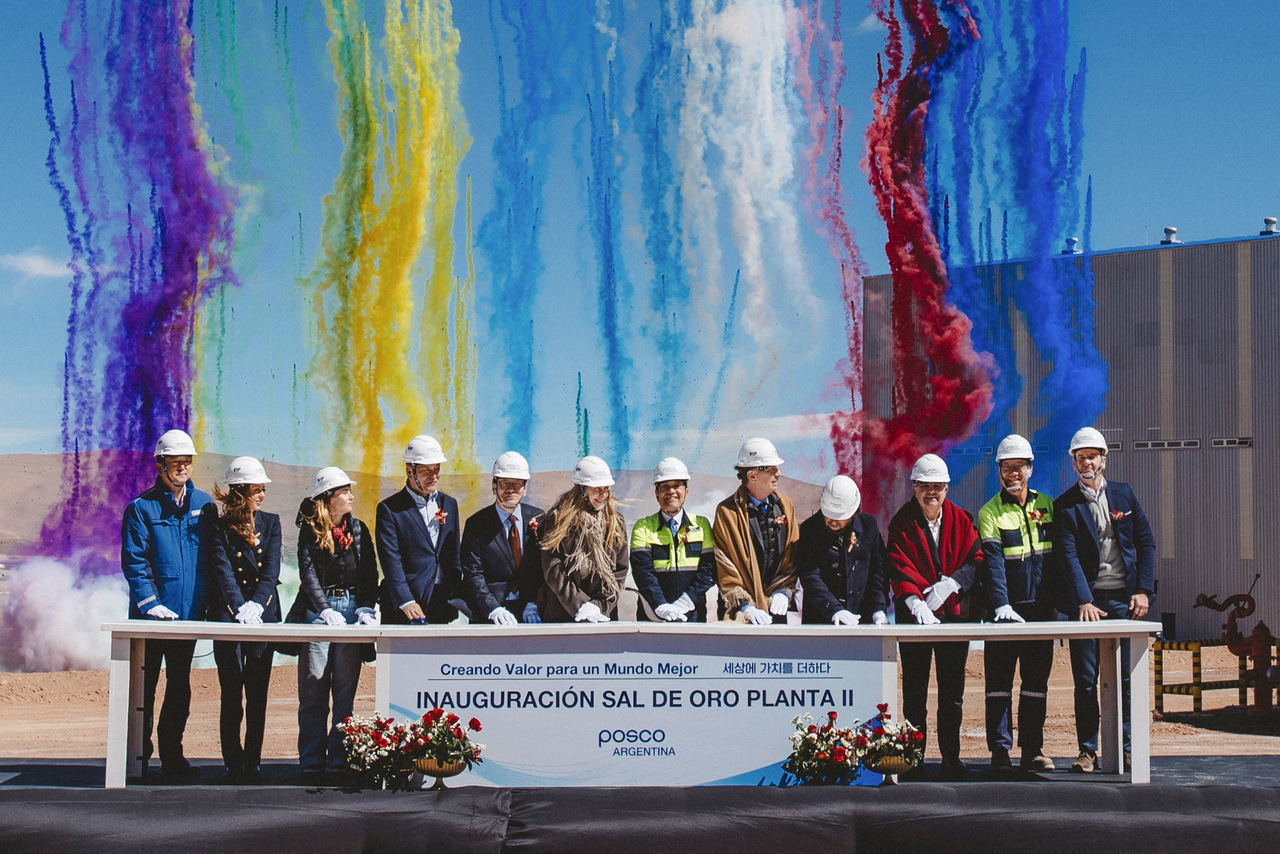
Posco Holdings, the holding company of Posco Group, held a completion ceremony Monday for the upstream process of its second brine lithium plant near the Salar del Hombre Muerto, located about 4,000 meters above sea level in Argentina.
Posco Group Chair Chang In-hwa attended the ceremony, along with Posco Argentina President Park Hyun, Argentine presidential chief of staff Karina Milei and South Korean Ambassador to Argentina Lee Jong-hwa, among others.
Posco invested about $954 million in the upstream portion of the second plant, which has annual capacity to produce 23,000 tons of lithium carbonate.
When combined with the first plant, which has been operating since 2024 with an annual capacity of 25,000 tons, Posco’s lithium production capacity in Argentina has increased to about 48,000 tons a year.
Lithium carbonate produced at the second plant will be sent to a downstream facility now being built at the Yulchon Industrial Complex in South Jeolla Province. The Korean facility, scheduled for completion next year, will convert the materials into 25,000 tons of battery-grade lithium hydroxide each year.
Together with existing capacity, the project will give Posco an independently operated brine-based lithium hydroxide production system with an annual capacity of about 50,000 tons.
The milestone also marks the culmination of efforts by Chang, who first began exploring lithium resources in Argentina in 2014 while leading Posco’s new business division.
“Since 2014, as the head of the new business division, I have personally visited sites in search of salt lakes suitable for lithium development,” Chang said. “It is deeply meaningful to see the project reach completion after overcoming numerous challenges in the extreme environment at an altitude of 4,000 meters.”
He added that with the completion, Posco Group has taken another step toward becoming a resource development company representing South Korea.
“We will continue to secure competitive resources in advance, turn them into production and earnings and ensure a stable supply of critical minerals needed by South Korean industries,” he said.
Posco Holdings plans to bring the second plant to full operation quickly while stepping up investment in its planned third and fourth plant as part of a goal to reach annual brine lithium production capacity of 100,000 tons by 2033.
The proposed third and fourth plants would each have an annual capacity of 25,000 tons.
Following an inspection of the new facilities Monday, Chang signed a memorandum of understanding with the governments of Salta and Catamarca provinces to pursue third and fourth lithium plants.
sahn@heraldcorp.com